Furniture Assets preserves furniture as tangible design and cultural assets.
This collection includes furniture created by renowned designers, anonymous craftsmen, traditional makers, and cultural traditions from different periods and regions. Each piece is documented and preserved as a physical object that reflects its design, materials, craftsmanship, construction methods, historical background, and cultural significance.
The collection currently includes works such as Eames chairs, a large hexagonal rosewood dining set, a Black Walnut live-edge table, The Chair, and other significant furniture pieces collected throughout a lifetime of observation and appreciation.
Within 22degrees Digital Museum, Furniture Assets focuses on the furniture itself. The purpose of this collection is to preserve and document the physical characteristics, provenance, design value, materials, construction, and cultural importance of each piece for future generations.
Experiences, memories, observations, interpretations, and research related to these objects are preserved separately within the archive system.
Traditional Large Hexagonal Rosewood Meeting Table and Chair Set
Eames Chairs
The Okinawa Collection Table
Black Walnut Live-Edge Slab Table
The Chairs and The Longest-Serving Chairs
The Artist created Green Chair
Furniture Assets は、デザイン・職人技・文化・記憶・人間体験が交差する家具を保存するコレクションの旅です。
家具を単なる道具ではなく、その時代の思想、素材、技術、暮らし方、価値観を伝える文化資産として記録します。
イームズチェア、六角形紫檀テーブルセット、ブラックウォルナット一枚板テーブル、The Chair などを含み、家具そのものを公開保存するという旅を想定しています。
大型六角形紫檀系会合テーブル・椅子セット
イームズ チェア
The Okinawa collection Table
ブラックウォールナット一枚板テーブル
The Chair( the long oldest one, green artist one,,,,)
22degrees Furniture Asset
ID-22-FA-001
Hexagonal Chinese / Taiwanese Meeting Table Set
Provenance Research Log Vol.1
Related Assets
・Furniture Asset
・Furniture Archive
・Material Archive
・Architecture Archive
・Research Archive
・Human Experience Archive
・Cultural Asset Archive
公開ログ 第1版
ID
22-FA-001
Title
六角形紫檀系大型会合テーブル・椅子セット
Chinese / Taiwanese Hexagonal Meeting Table and Chair Set
Provenance Under Research
公開日
2026年6月7日
分類
Furniture Archive
Cultural Asset Archive
Material Archive
Research Archive
Human Experience Archive
概要
本記録は、所有者が1995年〜1997年頃、最有力推定では1996年頃に、福岡市中央区赤坂・けやき通り周辺にあった「ほんとく商店」で購入し、現在保有保管している大型六角形家具セットについての公開ログ第1版である。
本家具セットは、六角形を基本構造とする大型テーブル1台と椅子8脚で構成される。
テーブルは六人掛けとして使用できる構造を持ち、六つの引き出し、六面それぞれに異なる六文様、中央六角支柱、18角形天板形状を備えている。
椅子にも花鳥・鳳凰・植物文様などの装飾が施され、全体として単なる食卓ではなく、会合・接客・儀礼的空間に置かれる家具であった可能性がある。
現時点では正式鑑定は未実施であり、制作年代、制作地域、正式材質は未確認である。
ただし、所有者の記憶、購入経緯、写真確認、過去に実物を見た学術研究者らの反応、そして横河健先生設計の日本橋住宅「八丁堀・櫻庵」において長期使用・保存され、新建築社撮影写真にも写っている事実を総合すると、本家具セットは単なる中古家具ではなく、未調査の文化資産候補として記録・保存・研究を進める価値があると考える。
来歴
所有者は2026年時点で59歳である。
本家具セットは、福岡に会社勤務時代に購入したものであり、百道浜に居住し始めて約1年程度経過した頃に購入した可能性が高い。この勤務歴・居住歴から逆算すると、購入時期は1995年〜1997年頃、最も可能性が高いのは1996年頃と推定される。
購入店は「ほんとく商店」である。
店名については所有者が明確に記憶しており、本家具セットを同店で購入したことは確定情報である。
ほんとく商店は1967年創業の骨董・古美術・アンティークを扱う専門店であり、所有者が購入した当時、福岡市中央区赤坂・けやき通り周辺に店舗があったことも公式情報と整合している。
所有者は、同店で江戸時代から明治時代頃に使われた可能性のある長持のような歴史的木製収納箱が複数販売されていたことも明確に記憶し本品は店の一番奥に保存展示されていたものである。
この記憶は、本家具セットそのものの年代を直接証明するものではないが、ほんとく商店が単なる中古家具店ではなく、歴史的な道具や古美術的価値を持つ品を扱う店であったことを示す重要な補助情報である。
購入価格は当時約50万円であったと記憶があり推定している。
1990年代半ばの50万円という価格は、一般的な中古家具としては高額であり、購入時点から高級古美術家具または高級工芸家具として扱われていた可能性がある。
構造
本家具セットの中心となるテーブルは、六角形を基本とする大型テーブルである。
ただし、天板は単純な六角形ではなく、六角形の各辺または各面にさらに面取りが施され、上から見ると18角形の形状を持つ。
所有者は購入直後、この特殊な18角形に近い天板形状に合わせて、厚さ約1センチ程度の特注ガラスをガラス店に依頼して製作した。
その後約30年間、この特注ガラスによって天板表面を保護しながら使用・保存してきた。
テーブルは中央一本支柱で支えられており、その支柱も六角形を基本とした多面構造を持つ。
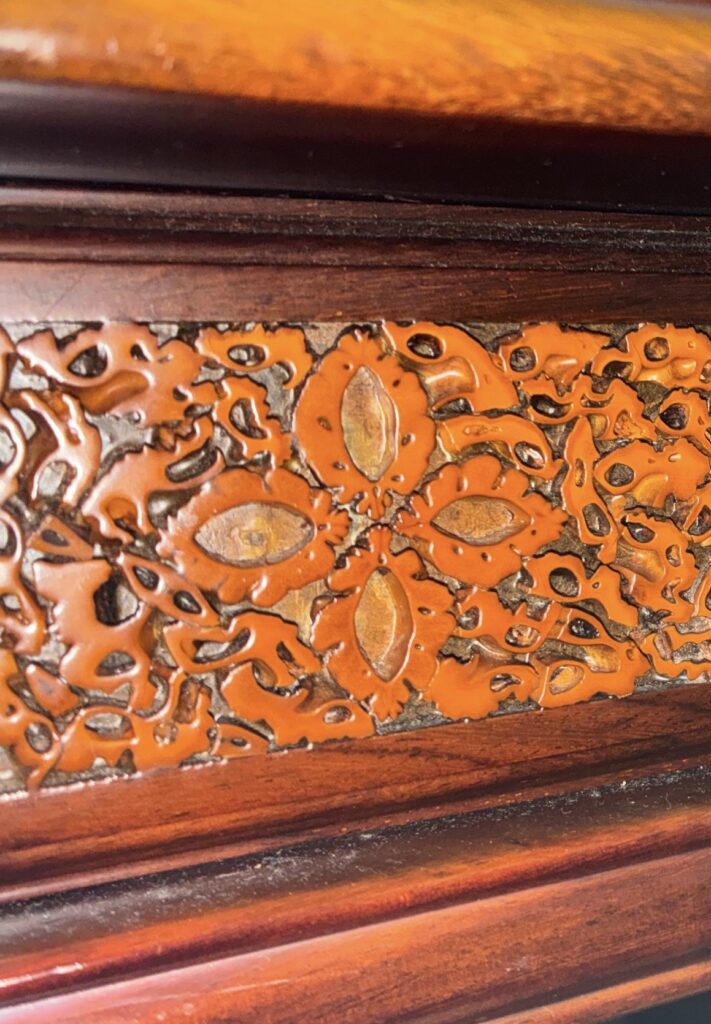
支柱の六面にもそれぞれ異なる装飾文様が施されている。
テーブルには六つの引き出しがあり、六人それぞれが独立して使用できる構成になっている。
引き出しの取手にも装飾性があり、桃の形状を示し、不老長寿、魔除け、子孫繁栄という縁起を願う文様して単なる実用品ではなく、家具全体の意匠体系の一部として作られている。
椅子は8脚である。
これは所有者の記憶だけでなく、購入当時および現時点での現物確認に基づく確定情報である。
椅子の背面にも異なる文様が施されており、特に鳳凰文様を含む高度な美しい装飾が確認される。
材質
所有者の認識では、本家具セットの主要材は紫檀である。
写真確認では、濃色の縞木目、高密度な硬木らしい質感、重厚な表面感が見られ、安価な量産家具用材には見えない。
ただし、正式な材質鑑定は未実施である。
今後、紫檀、紅木、酸枝木、黄花梨、鉄刀木、花梨などとの比較確認が必要である。
装飾部分には、柘植、花梨、胡桃、または別種の硬木と思われる明るい色の材が使われている可能性がある。
特に透かし彫り・象嵌・寄木的に見える部分は、今後の材質・工法調査において重要な対象となる。
文様
本家具セットの大きな特徴は、六角形構造と六面異文様である。
所有者の認識および写真確認では、鳳凰、牡丹、竹、梅、東洋蘭、鳥、花、雲文、植物文様などが確認または想起される。
六面それぞれに異なる文様が施されていることが、所有者がこの家具を購入した最も重要な理由の一つであった。
椅子の背面にも鳳凰や花鳥文様が施されており、テーブルと椅子が一体の意匠体系として設計されている可能性がある。
このような六角形、六席、六引き出し、六面異文様、八脚椅子、花鳥文様、鳳凰文様の組み合わせは、単なる装飾家具ではなく、一定の思想・用途・格式を持つ家具であった可能性を示している。
工法
所有者の認識では、本家具セットはテーブル、椅子、引き出しを含め、釘や金物を使用せず、木組みによって構成されている。
写真確認では、椅子の接合部、天板縁、引き出し周辺、支柱部分において、安価な量産家具に見られる露出ネジや簡易金具は目立たない。
接合部や面取り部分には、かなり丁寧な加工が見られる。
透かし彫りまたは象嵌的な装飾部分は、非常に細密であり、単なるプリントや表面的な模様ではなく、立体的な工芸技法によって構成されている可能性が高い。
正式な工法判定には専門家の実物確認が必要である。
用途に関する記憶
所有者は購入当初、本家具セットを大型の食卓・ダイニングテーブルとして理解していた。
しかし、日本橋の自宅で保存・使用していた際、住宅取材に同行していた東洋史または歴史的家具に詳しい研究者と思われる人物が実物を見て強い関心を示し、一般的な食卓ではなく、重要な会議室や会合の場に置かれるような会合用テーブルであった可能性について言及していた記憶がある。
六角形、六人掛け、六引き出し、六面異文様という構成は、単なる日常食卓よりも、接客・会合・儀礼的用途を想起させる。
ただし、現時点では用途は未確定であり、今後の専門調査が必要である。
中国・台湾との関連に関する記憶
所有者の記憶では、過去にこの家具を見た研究者が、中国と台湾の歴史的関係について話し、この家具が中国から台湾へ渡り、台湾から日本へ来た可能性について言及していたような記憶が断片的にある。
また、明または清という歴史的時代について話していたような記憶もある。
ただし、これらは現時点では所有者の断片的記憶であり、正式な鑑定や文献確認によって裏付けられたものではない。
本公開ログでは、これらを「可能性」または「過去に聞いた記憶」として記録し、断定は行わない。
日本橋住宅での保存履歴
購入後、本家具セットは福岡勤務ののち、日本橋の自宅に搬入され、長期間使用・保存された。
この住宅は横河健先生設計の住宅「八丁堀・櫻庵」である。ウェブサイトには「八丁堀・櫻庵」として紹介されており、掲載写真には本家具セットが室内中央に配置されている様子が確認できる。
写真には「撮影/新建築社」と記載されている。
これにより、本家具セットは単に個人宅で保管されていた家具ではなく、建築作品として記録された空間の中心的家具として存在していたことが分かる。
吹抜け空間の中央、ダイニング・会合的な位置、外部からも見える象徴的な場所に配置されており、住宅空間の印象を形成する重要な家具として機能していた。
この事実は、本家具セットの来歴において非常に重要である。
本家具は、福岡のほんとく商店で購入された後、横河健先生設計の都市型住宅「八丁堀・櫻庵」で長期使用・保存され、新建築社撮影写真にも記録された家具である。
第三者による所見の記憶
日本橋住宅の取材時、雑誌編集者に同行していた人物が、東洋史、東洋文化史、または歴史的家具に詳しい学術研究者であったと所有者は記憶している。
その人物は本家具セットを実物で見た際に非常に驚き、「これは非常に価値のあるものではないか」という趣旨の発言をした。
また、中国または台湾由来、第二次世界大戦以前に日本へ渡来した可能性、中国から台湾を経由して日本に来た可能性、明・清などの古い時代との関係について言及していたように所有者は断片的に記憶している。
正式な鑑定書は存在しないが、実物を見た専門家らしき人物が強い関心を示したという事実は、今後の来歴調査において重要な証言候補と考えられる。
現時点での確認済み情報
・本家具セットは、福岡市中央区赤坂・けやき通り周辺にあった「ほんとく商店」で購入された。
・ほんとく商店は1967年創業の骨董・古美術・アンティークを扱う専門店である。
・購入時期は1995年〜1997年頃、最有力推定は1996年頃である。
・購入価格は約60万円〜80万円である。
・テーブルは1台である。
・椅子は8脚である。
・引き出しは6個である。
・購入後約30年間以上、所有者が継続所有している。
・購入直後から特注ガラスにより天板を保護している。
・日本橋の横河健先生設計住宅「八丁堀・櫻庵」で長期使用・保存されていた。
・ウェブサイト掲載写真および新建築社撮影写真に、本家具セットが室内中央に写っている。
・2026年6月7日時点で千葉に所有者が保有、現存している。
現時点での未確認事項
・正式な制作年代
・正式な制作地域
・正式な材質
・中国製か台湾製か
・中国から台湾を経由して日本へ来たかどうか
・戦前渡来品かどうか
・明代、清代、民国期、戦後初期、近代復刻品のいずれか
・会議卓、会合卓、接客卓、食卓のどれとして作られたものか
・工房、作者、制作地
・ほんとく商店における仕入れ経路
・当時の販売記録または領収書の有無
・住宅取材時に実物を見た学術研究者の氏名および正式所見
現時点での評価
本家具セットは、現時点では正式鑑定未実施であるため、年代・材質・制作地を断定することはできない。
しかし、購入店、購入時期、購入価格、構造、装飾、保存履歴、日本橋住宅での使用履歴、新建築社撮影記録、第三者研究者の反応を総合すると、一般的な中古家具ではなく、専門的調査を行う価値を有する高級工芸家具・未調査文化資産候補として扱うべきである。
特に、六角形構造、六引き出し、六面異文様、八脚椅子、鳳凰・牡丹・梅・竹・蘭などの東アジア的文様、紫檀系硬木の可能性、木組み構造、長期保存、建築作品内での記録という複数の要素が重なっている点が重要である。
本家具セットの価値は、家具単体の市場価値だけでなく、来歴、保存記録、建築空間との関係、研究過程によって高まる可能性がある。
保存方針
本家具セットは、正式調査が完了するまでは、普通の家具として扱わず、未調査文化資産候補として慎重に保存する。
直射日光を避ける。
湿度の急変を避ける。
エアコンの直風を避ける。
濡れ拭きをしない。
ワックスを塗らない。
オイルを塗らない。
研磨しない。
再塗装しない。
改造しない。
部品交換しない。
分解しない。
移動は最小限にする。
現状写真、寸法、動画、保存環境、使用履歴を継続的に記録する。
今後の調査予定
第1段階
現状写真アーカイブの作成。
テーブル全景、天板、六面文様、引き出し、支柱、椅子8脚、椅子背面、接合部、裏面、細工拡大を番号付きで記録する。
第2段階
過去写真の発掘。
日本橋住宅時代の写真、新建築社撮影写真、ウェブサイト掲載公開写真、当時の住宅雑誌資料を整理する。
第3段階
来歴調査。
ほんとく商店の沿革、赤坂店舗、当時の取扱品、可能であれば販売記録や関係者証言を確認する。
第4段階
専門家相談。
東京国立博物館、東京文化財研究所、中国家具研究者、東洋美術・東洋工芸・家具史の専門家に相談する。
第5段階
22degrees Digital Museumでの継続公開。
新たに判明した情報を公開ログとして追記し、価値発見の過程そのものを保存する。
22degrees Digital Museumにおける位置づけ
本家具セットは、Furniture Archiveに収蔵する。
ただし、単なる家具記録ではなく、以下のRelated Assetsと接続する。
Related Assets
Furniture Archive
Material Archive
Cultural Asset Archive
Research Archive
Architecture Archive
Human Experience Archive
理由は、本家具セットが家具としての造形価値だけでなく、素材、工芸、東アジア文化、福岡の古美術商、日本橋の建築空間、新建築社写真、所有者の30年の保存体験、そして22degrees Digital Museumにおける再発見のプロセスを含んでいるためである。
公開方針
本公開ログでは、現時点で確認されている事実と、所有者の記憶に基づく可能性を分けて記載する。
明代、清代、戦前渡来、中国から台湾を経由して日本へ来たという内容については、現時点では断定せず、今後の調査課題として扱う。
本記録は完成された鑑定資料ではなく、価値を少しずつ明らかにしていくための公開型研究ログである。
今後、写真、寸法、専門家所見、文献調査、ほんとく商店に関する情報、住宅との関係、新建築社掲載資料などを追加し、記録の厚みを増していく。
暫定結論
本家具セットは、1995年〜1997年頃、最有力推定では1996年頃に、福岡市中央区赤坂・けやき通り周辺にあった1967年創業の骨董専門店「ほんとく商店」で購入された大型六角形家具セットである。
テーブル1台、椅子8脚、六引き出し、六面異文様、中央六角支柱、18角形に近い天板、鳳凰・牡丹・竹・梅・東洋蘭などの文様、高度な透かし彫り・象嵌的装飾、紫檀系硬木の可能性を備えている。
購入後は、日本橋住宅「八丁堀・櫻庵」で長期使用・保存され、新建築社撮影写真にも記録された。
現時点では正式鑑定は未実施であるが、未調査文化資産候補として、今後継続的に保存・研究・公開していく価値があると考えられる。
This record is Version 1 of a public research log documenting a large hexagonal furniture set currently owned and preserved by the owner. The set was purchased from Hontoku Shoten, located in the Akasaka and Keyaki-dori area of Chuo-ku, Fukuoka, between approximately 1995 and 1997, with 1996 considered the most likely year of purchase.
The furniture set consists of one large table based on a hexagonal structure and eight chairs.
The table was designed to accommodate six users and features six drawers, six individually decorated sides, a central hexagonal pedestal support, and an eighteen-sided tabletop form.
The chairs are also decorated with motifs including birds, flowers, phoenixes, and plants. As a whole, the set may have originally served not merely as a dining table but as furniture intended for meetings, reception spaces, or ceremonial environments.
At present, no formal appraisal has been conducted. The date of manufacture, place of production, and precise material composition remain unverified.
However, considering the owner’s memories, the circumstances of purchase, photographic documentation, reactions from academic researchers who examined the furniture in the past, and the fact that the set was used and preserved for many years in “Hatchobori Ouan,” a residence designed by architect Ken Yokogawa and photographed by Shinkenchiku-sha, the owner believes that this furniture set should be regarded not as ordinary second-hand furniture but as a candidate cultural asset worthy of documentation, preservation, and research.
Provenance
The owner was 59 years old as of 2026.
The furniture set was purchased during the owner’s years working in Fukuoka. Based on the owner’s recollection, it was most likely acquired approximately one year after moving to Momochihama.
Based on the owner’s employment and residential history, the estimated purchase period is between 1995 and 1997, with 1996 being the most likely year.
The furniture was purchased from Hontoku Shoten.
The owner clearly remembers the store name and is certain that the furniture set was purchased there.
Hontoku Shoten is a specialist dealer in antiques, fine art objects, and historical artifacts established in 1967. Official information confirms that the shop operated in the Akasaka and Keyaki-dori area of Chuo-ku, Fukuoka during the period when the purchase was made.
The owner also clearly remembers seeing multiple historical wooden storage chests similar to traditional Japanese nagamochi, which may have dated from the Edo or Meiji periods, being sold at the store.
While this memory does not directly prove the age of the furniture set itself, it supports the understanding that Hontoku Shoten was not merely a second-hand furniture store but a dealer handling historical objects and items with cultural and artistic value.
The owner recalls the purchase price as approximately 600,000 to 800,000 Japanese yen.
For the mid-1990s, this was a substantial amount for furniture and suggests that the set may already have been regarded as a high-end antique or fine craft object at the time of purchase.
Structure
The central element of the furniture set is a large table based on a hexagonal form.
However, the tabletop is not a simple hexagon. Each side is further chamfered, creating an overall eighteen-sided appearance when viewed from above.
Immediately after purchase, the owner commissioned a custom-made glass top approximately 1 cm thick, specially manufactured to match the unique eighteen-sided tabletop profile.
For more than thirty years, this glass has protected the surface while the table remained in active use and preservation.
The table is supported by a single central pedestal, itself based on a hexagonal multi-sided structure.
Each of the six sides of the pedestal is decorated with different ornamental motifs.
The table contains six drawers, allowing six users to independently use the table.
Even the drawer handles are decorative and appear to have been designed as part of the overall artistic composition rather than merely functional hardware.
The set includes eight chairs.
This is not merely based on memory but is confirmed by both the original purchase and present-day physical verification.
The backs of the chairs display individual decorative motifs, including highly detailed and elegant phoenix imagery.
Materials
According to the owner’s understanding, the primary material of the furniture set is zitan (rosewood).
Photographic examination reveals dark striped grain patterns, dense hardwood characteristics, and a substantial visual presence that does not resemble inexpensive mass-produced furniture materials.
However, no formal wood identification has yet been conducted.
Future investigation should compare the materials against zitan, hongmu, suanzhi, huanghuali, ironwood, and huali.
Lighter-colored woods appearing in the decorative sections may include boxwood, huali, walnut, or other hardwood species.
Particularly important for future study are the areas that appear to incorporate openwork carving, inlay, or marquetry-like construction techniques.
Decorative Motifs
One of the most distinctive characteristics of this furniture set is the combination of a hexagonal structure and six individually decorated sides.
Based on the owner’s observations and photographic evidence, motifs include phoenixes, peonies, bamboo, plum blossoms, orchids, birds, flowers, cloud patterns, and plant imagery.
The fact that each of the six sides features a different decorative composition was one of the primary reasons the owner purchased the furniture.
The chair backs also incorporate phoenix and floral-bird motifs, suggesting that the table and chairs may have been conceived as a unified artistic ensemble.
The combination of a hexagonal structure, six seating positions, six drawers, six individually decorated sides, eight chairs, floral-bird imagery, and phoenix motifs suggests that the furniture may have possessed specific symbolic, ceremonial, or social significance beyond simple decoration.
(continued in future research logs)
Construction Methods
According to the owner’s understanding, the furniture set was constructed without the use of nails or metal fasteners and instead relies primarily on traditional wooden joinery.
This understanding applies to the table, chairs, and drawers as a unified furniture system.
Photographic examination reveals no obvious exposed screws, simple brackets, or visible modern hardware commonly found in inexpensive mass-produced furniture.
The joints, chamfered edges, and transitions between components appear carefully executed.
The decorative sections, which resemble openwork carving, inlay, or marquetry, display a high degree of detail and craftsmanship.
Rather than appearing as printed or surface-applied decoration, these elements appear to possess physical depth and dimensional construction.
However, a definitive assessment of the construction methods requires direct examination by specialists.
Memories Regarding Original Function
When the owner first acquired the furniture set, it was understood primarily as a large dining table.
However, while the furniture was being used and preserved in the Nihonbashi residence, an individual believed to be knowledgeable in East Asian history and historical furniture examined the piece and expressed strong interest.
The owner recalls that this individual suggested the furniture may not originally have been intended as an ordinary dining table, but rather as a meeting table used in formal gatherings, reception rooms, or ceremonial settings.
The combination of a hexagonal structure, six seating positions, six drawers, and six individually decorated sides appears more consistent with a formal social or ceremonial function than with everyday dining.
At present, however, the original function remains unconfirmed and requires further research.
Memories Concerning China and Taiwan
The owner retains fragmentary memories of conversations with a researcher who examined the furniture in the past.
According to those recollections, the researcher discussed historical connections between China and Taiwan and suggested the possibility that the furniture may have traveled from China to Taiwan and later from Taiwan to Japan.
The owner also recalls references to the Ming or Qing periods being mentioned during those discussions.
These recollections remain unverified and should not be interpreted as established facts.
Within this public research log, they are recorded only as memories and possibilities rather than conclusions.
Preservation History in Nihonbashi
After its acquisition in Fukuoka, the furniture set was eventually relocated to the owner’s residence in Nihonbashi, Tokyo.
The residence was “Hatchobori Ouan,” a house designed by architect Ken Yokogawa.
The project is introduced on the architect’s official website, where photographs clearly show the furniture positioned at the center of the interior space.
The published images are credited to Shinkenchiku-sha.
These photographs demonstrate that the furniture was not simply stored in a private residence but functioned as a central furnishing element within a documented architectural work.
The furniture occupied a highly visible position beneath the central atrium and served as a focal point within the spatial composition of the house.
Its placement suggests that it played an important role in shaping the atmosphere and identity of the residence.
This aspect of its history forms a significant part of its provenance.
The furniture was purchased from Hontoku Shoten in Fukuoka and subsequently preserved for many years within Hatchobori Ouan, where it became part of a documented architectural environment.
Memories of Third-Party Observations
During a magazine interview and residential documentation project, an individual accompanying the editorial team examined the furniture.
The owner recalls that this person possessed academic expertise related to East Asian history, East Asian culture, or historical furniture.
Upon seeing the furniture, the individual reportedly expressed considerable surprise and suggested that it could be an object of substantial significance.
The owner also remembers references to possible Chinese or Taiwanese origins, possible arrival in Japan prior to World War II, and potential connections to older historical periods such as the Ming or Qing dynasties.
No written appraisal or formal evaluation exists.
Nevertheless, the strong reaction of a knowledgeable observer remains an important part of the furniture’s documented history.
Verified Information as of June 7, 2026
• Purchased from Hontoku Shoten in the Akasaka and Keyaki-dori area of Chuo-ku, Fukuoka.
• Hontoku Shoten was established in 1967 and specializes in antiques, fine art objects, and historical artifacts.
• Estimated purchase period: 1995–1997, with 1996 being the most likely year.
• Estimated purchase price: approximately ¥600,000–¥800,000.
• One table.
• Eight chairs.
• Six drawers.
• Continuously owned for more than thirty years.
• Protected by a custom-made glass top since acquisition.
• Preserved and used in Hatchobori Ouan, a residence designed by Ken Yokogawa.
• Appears in photographs published on the architect’s website and photographed by Shinkenchiku-sha.
• Currently owned and preserved in Chiba Prefecture as of June 7, 2026.
Items Not Yet Verified
• Exact date of manufacture.
• Exact place of manufacture.
• Precise wood species.
• Whether the furniture was made in China or Taiwan.
• Whether it traveled from China to Taiwan and subsequently to Japan.
• Whether it arrived in Japan before World War II.
• Whether it belongs to the Ming, Qing, Republican, postwar, or later periods.
• Original intended function.
• Workshop, maker, or place of production.
• Acquisition route prior to its arrival at Hontoku Shoten.
• Existence of original sales records or receipts.
• Identity and formal opinion of the researcher who examined the furniture.
Current Assessment
At present, the furniture has not undergone formal appraisal.
Therefore, its age, materials, place of manufacture, and historical significance remain unconfirmed.
However, when considering its purchase history, price, structure, decoration, long-term preservation, documented presence within a significant architectural work, photographic records, and the reactions of knowledgeable observers, the furniture appears to warrant serious study.
The combination of a hexagonal structure, six drawers, six individually decorated sides, eight chairs, East Asian symbolic motifs, possible rosewood construction, traditional joinery, and documented preservation history makes it an unusual and potentially important object.
Its significance may ultimately derive not only from the furniture itself but also from its provenance, preservation history, architectural context, and ongoing research.
Temporary Conclusion
This furniture set was most likely purchased in approximately 1996 from Hontoku Shoten, a long-established antique dealer founded in 1967 in the Akasaka area of Fukuoka.
The set consists of one table, eight chairs, six drawers, six individually decorated sides, a central hexagonal pedestal, an eighteen-sided tabletop, phoenix and floral motifs, intricate openwork and inlay-like decoration, and possible rosewood construction.
Following its acquisition, it was preserved for many years in Hatchobori Ouan, a residence designed by architect Ken Yokogawa, and appears in photographs taken by Shinkenchiku-sha.
Although no formal appraisal has yet been conducted, the owner believes that the furniture should be regarded as a candidate cultural asset worthy of continued preservation, research, and public documentation.
This document is not intended as a final appraisal.
Rather, it serves as the first public research log in an ongoing effort to document, preserve, and better understand the significance of this furniture set over time.